

1 - The Feast
Holding leaves with a long breeze, a basil bunch was on its way to a Mihmani. A feast hosted by bright rosemaries to discuss shared dreams and connect roots in good company.
Looping playfully over the guests before dropping the basils off gently, LoopDoop breezed past with bright glee. Most likely off to the tomato gardens, or perhaps where sage leaves gathered in bundles of five to seventeens. But it had learned its lesson about visiting the mints. Rarely in their garden as they should be. If not on a closeby adventure in conversation with other herbs, they were under rocks overlooking the fern forests or distant trees.
Some creations enjoyed the company of mints more than others but none more than rocks. Mainly due to mints always being in endless conversations amongst themselves while in others’ company. And since garden rocks liked listening, they enjoyed having the mints to hear their stories.
“Basil and breeze go together,” a yellow onion leading a large family of garlic bulbs, leeks, scallions, and shallots stated excitedly with curled roots. “But they always arrive last,” added one among the group, completing the second, unofficial, half of the proverb. This prompted laughs from guests other than the onion group.
As always, prior to the main event, the basils had asked LoopDoop to first take them somewhere else. This time it was a short visit down south to fulfill a promise they’d made to the hosts.
Leafy ferns, planted directly south of the gardens and west of the Tree Fern Forest, had a unique sense of humor that was best appreciated by their northern neighbors. The legendary mint Na’ana’s song* about them was a commonly quoted one from the Mint Rubaiyat*:
“I was told the same joke twice,
once by a fern, another by a moss.
And though my roots curled both times,
they were different kinds of smiles.”
Like mints, basils enjoyed a wide range of social encounters, only in quicker doses. Which is why some herbs referred to Na’ana as a mint-basil, though mints didn’t approve of this.
The similarities and differences between leafy ferns and basils made them enjoy the occasional meetings between them. Basil bunches were young and bright, talkative but plenty witty. Leafy ferns, unlike their twisted-trunked fern tree counterparts, were a tranquil canopy of unfurling fractal cascades. Therefore, a breezy basil visit from time to time was an adventure all to itself. This time, as always, LoopDoop had risen into a big loop and rapidly dropped, announcing the playful arrival of the basil to ferns. All the while, the neat forest had waited with gentle anticipation and sarcastic “Ohoooo,”s making it sound as though the mountains had arrived from the west.
At the Mihmani, on that fair field where soil was rich, rosemaries were welcoming guests and directing them to spots they’d picked for each. Experts in the art of hosting, rosemaries had long been arranging feast circles by positioning guests introvert next to extrovert with the purpose of keeping the center soil loose and not overwhelmed by few voices.
The rosemaries welcomed the basil bunch warmly and in a brief exchange understood that their request had been fulfilled. Next, the basils unbunched and each stem rooted toward its designated spot.
With the feast arrangement slowly shaping, a bright mingle was emerging. A borage plant with vivid blue flowers and fuzzy leaves said to a valerian root, “Bright you are, may I ask where you journeyed from?” Further away, a smilax evergreen was complementing an Osage orange’s short trunk.
Of them all, the elders were the most merry. Especially Tuta Mulberry and its faithful beloved, Sawfa Elderberry. Long had the Yārs been root-locked, and during the course of that bright relationship together they had helped sprouts on their journeys to becoming well-raised plants. One they were anticipating reuniting with after a long time was a young bonsai pine with a dancing trunk and branches that were exquisitely arranged.
When the moment finally arrived, Tuta stretched a root toward the pine and said, “Joy of life, healthy and bright. Is that a knot I sense between yours and the lush maple by your side?” Sawfa Elderberry had sensed the same. Their roots curled, the four headed toward their spots within the circle of guests, thanking bright for this overdue reunion.
“Yār,” called NoGooder, the tailed agave. Rooting slightly behind its root partner, GoodSmell, the agave’s large rosette of broad, blue-green leaves was beaming. “Thank bright that no matter on adventure or Mihmani, we’re always first in each other’s company.”
GoodSmell’s stem filled with joy. “My allgooder, gooder than good, no other good as good as you gooder,” the succulent Mother of a Thousand began its response. “Calling me by the brightest of all words, Yār, my forever companion and bright do-gooder.” Tickled, the clusters of florets on GoodSmell’s triangular leaves slowly opened their petals then promptly fell back into cute-sleep. “Bright is every moment I get to root with you my good-gooder.” With that, two new roots between them began forming new knots.
A ginger root called Zanjebil had managed to land a spot near one of the basils. “Bright you are dear basil,” it whispered.
“And you, elder ginger Zangebil,” responded the basil.
“May I ask? Did you visit the ferns prior to coming here?”
The basil curled a root and said, “there, indeed we were.”
“In that case,” said the ginger excitedly, “would you be so kind and make me the first to know, for I’m sure you left that forest with a new joke.”
The basil wasn’t surprised. That was the way of subterranean plants to find things out before all other plants. However, lucky for the basil, just at that moment the tea shrub master of ceremonies, spoke up, “Bright you all are and welcome to the field of rosemaries, this delightful Mihmani, where we shall discuss dreams in good company and make sense of them patiently. Before anything, on behalf of this bright circle and beyond, thank you rosemaries.” A soft murmur of gratitude filled the center circle. Then the tea shrub spoke again, “Before we begin, our hosts have graciously brought us the latest fern joke with the help of a bright basil bunch.” This time a joyous chorus of surprised oohs and aahs erupted from the guests.
Then the basils, each from where they were planted, extended their roots forward and their combined words recreated the joke in the soil for the waiting audience. “In the scenery of a quiet valley, two gray boulders crashed down for an untimely greeting. As guests with a reputation for not leaving, all the plants left instead so that they may be spared their guests' reason for visiting.”
The entire Mihmani burst into laughter, their curled roots nearly rattling the soil. “Not a gray rock, surely not,” some plants said. The Grays were an imaginary type of rock invented by ancient garden dwellers to use as a figure of speech when one of their own was being repetitive or slow. The leafy ferns used them as subjects for their jokes.
“Now let’s begin,” the tea shrub declared, taking a moment to subside its laughter before speaking. The rosemaries privately thanked the basils for their bright delivery.
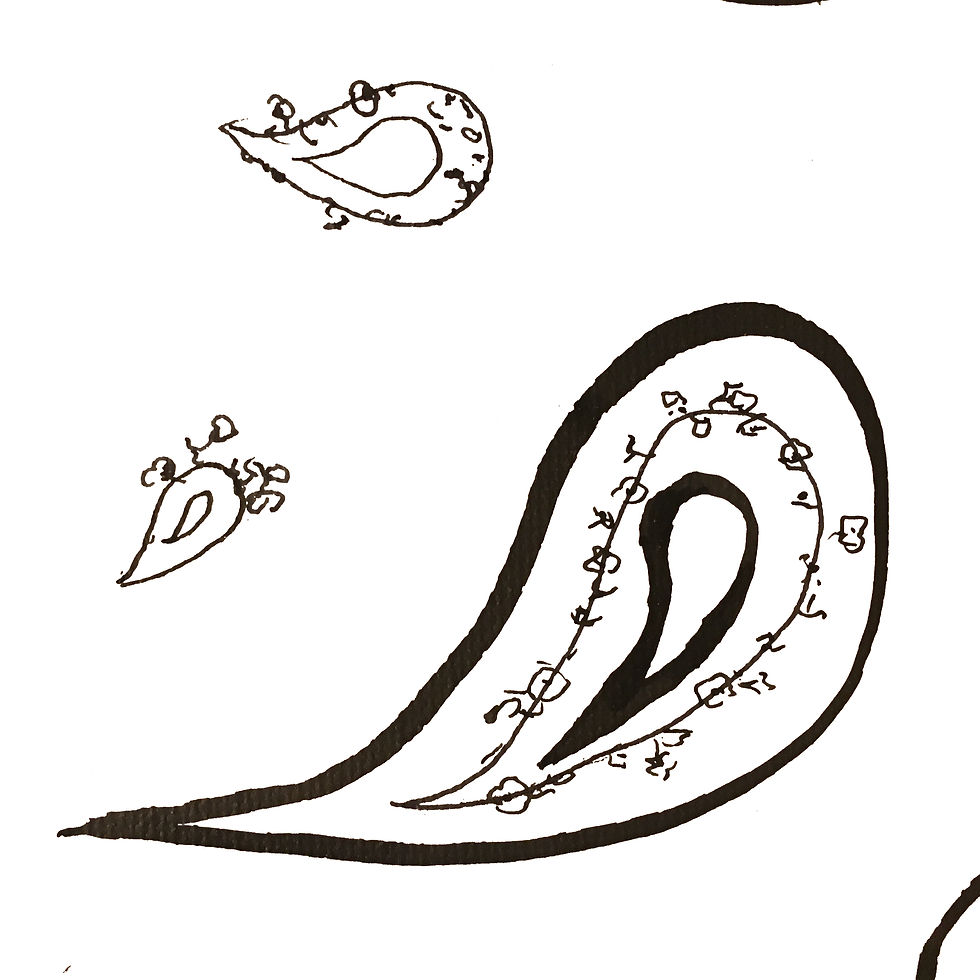
Gradually, the circle came back to shape and on track to begin with the Mihmani’s purpose. As usual, it was the introverts that started first. With outstretched roots, very slowly, words began filling the soil between guests. Soon, a detailed account of each guest’s whereabouts in Jajeem Valley and their positions in relation to the dancing Paislies was revealed.
An aloe vera recalled being on a steep slope, where a companion mountain wind made it slide from side to side and up and down. “There was so much joy in that.”
A meadowsweet with pink plumes called DulaRuba said it was planted high up on a redwood tree’s branch. “When the Paisleys appeared, we were not far from their glorious dance,” it reported, happy and proud. “The redwood told me there were mountains close by but next to the paisleys they seemed all too slight.”
“How did it feel on your roots with giant boulders surrounding you?” A silphium asked a skirret.
The Mihmani was in full swing now and the guests were joy-conversing. Once the memory of that illusive valley of shared dreams was relived through the recollection of many, it was time to discuss the trance, or as the tea shrub announced it, the “Dream within the first dream.”
Quietly, the guests dipped their roots back in the center circle and instantly, hazy visions unified into one focused and clear picture. A shapeless mountain incomprehensible in scale, pristine but dim, surrounded by folds of shade stretching into the infinite unknowns. Howling this way and that, keeping the gnawing shade off the slopes, a formidable wind dispersed scarce mountain bright to rocks and inside every cave.
Such was the beginning of all things for a long time in Giti with Mount Onna and its wind, Ut. Until at last bright was stretched to reach every cave, though frail and in parts barely distinguishable from shade. This alone was enough to awaken an ancient desire trapped within Onna’s rocks. The mountain rumbled and the first words were spoken, “Bright.”
Such was the power of the word that it caused the mountain and its companion wind to fracture. Several deep cracks appeared along the length of Onna, out of which, fresh bright spilled and all that had been dim was made brilliant.
Ut was unraveled into many winds, all blowing on the slopes without purpose or guidance at first. Of them, two winds, Va and Ra, blew side-by-side. With time and bright, they found kinship in exploring the newly formed fractures on Onna. The others found their way on the slopes too, chiseling and shaping its expanding surface by scattering bright dust over shade.
Time was timeless and it passed on by. Va and Ra widened hard gaps while at Onna’s roots shade was pushed back. And when bright conditions were just right, two new mountains emerged, young and grand.
Now fully in their own self-induced trance, the Mihmani witnessed clearly how the shapeless had finally taken shape. The smaller of the three mountains, tired and weathered, was now fully recognizable to all as the sleeping mountain at the center of Giti. And the largest now by a very long margin. They only knew about its reputation from Na’ana’s song:
“I heard from a rock that Onna was so massive
It could hold all the mountains on its slopes.
And those that dared climb its rocks
Were sure to be forever lost.”
Na’ana had famously said in old age that that was one adventure it dared not go on, though the temptation had always remained strong. Plants have since used Na’ana’s account as warning to any creation contemplating rooting toward the sleeping mountain. “Why leave good soil for an unsure adventure to cut your leaves from reaching old age?” they’d argue.
Esna and Venda were named by Onna, becoming heirs to many bright caves. Va and Ra were made companions to the new mountains as they had helped shape their departure from their creator. The other winds split to join them as helpers, leaving their elder to rest.
The shattering of Onna and Ut meant that no other creation had to endure having to stretch their bright and risk going gray. And from then on, all creations of bright were able to speak from the start.
“Hmm, Haa,” the twin peaks of Esna and Venda boomed. “First there was one, hmmmm, the age of, haaaaa, bright has begun, Haaa, Hmmmm.” And with that the two mountains jolted with an epic force and separated from one another, bright oozing from rocks, winds coming together as storms. Once the dust had settled, the two mighty mountains began their spiraling dance around and away from Onna. Each time a revolution around their elder creator was complete, new mountains divided out of their slopes. And they, too, danced and spread bright across dark lands.
Out of shade emerged plants into bright. They were unrecognized by the Mihmani, but understood to be ancestors to all their kinds. Those early plants were mere in size, lacking true roots, leaves or flowers, and in the beginning they were immobile. But with more mountains and the strengthening of bright, slowly they began marching the lands. Each generation of plants became stronger, greener and more at ease in the changing soil. From where mountain dust had blown sprouted more new kinds, which joined the native plants as companions.
Esna and Venda’s slopes finally flattened and grayed*. So did the mountains created by them. Slowly, mountains, too, changed. Instead of dancing alone, they joined in ranges, singing together the ancient song of, “First there was one, then there was bright.” They came and went too until finally there was enough bright to sustain mountains and plants without fear of shade causing Gray Outs*. And only then, the dance of the mountains and plants came to a momentary halt to enjoy a glorious sight. The Mihmani witnessed the first dance of the Paislies on green slopes, marking the first celebration of Giti’s creations.
But the elder mounts were not finished. After celebrating their ancestors' sacrifices with the young rocks, they agreed amongst themselves to be the final mountains to Gray Out for the betterment of bright. Bidding the concert farewell, they rushed toward shade from all directions and disappeared forever. And bright was expanded even further to its current limits.
This event was what rocks and plants had since named the Noble Act. Generation after generation had passed the memory on, but now the Mihmani was witnessing firsthand the very rocks and bent peaks, their courage and glory. The guests were awestruck, roots and stems motionless, leaves unturned.
What appeared before them next was the slow changing of Giti’s brightness as new creators emerged. Gems parted out of heirs of Venda, raised as giants by bright GemModder. Mighty shihuahuaco trees commonly known among plants as Ironwood trees of the Sorb Forest, were created by mount Rhyolite, the pink granite present in that first paisley concert.
One after another, creators were mountain rocks as they were ancient and bore early memories in their caves and crusts. And always, for every new creation the Paislies came out to dance, each time in a different place.
With that, the Mihmani sensed the end of the trance and were about to conclude sharing to return and discuss, when suddenly an untraceable input was sensed in the center circle. The guests immediately erupted in a flurry of excited reactions as they learned that on this occasion, and for the first time, the Paislies had celebrated a plant created by another plant. Nothing else was shared beyond that and the Mihmani remained in silent contemplation for a very long time.
------------
Songs - passed down fables and stories.
Mint Rubaiyat - A collection of rubais (songs in quatrains) attributed to mints. While many creations pass down their songs in the rubai format, the Mint Rubaiyat is unique in that many of the songs were not created by mints but by creations that came in contact with them. There is no consensus among plants of how many songs make up the Mint Rubaiyat (Mints inflate the numbers while roots downplay them) but it is agreed that Na’ana’s adventures make up almost all of it.
Gray Out - If a creation comes in contact with shade, depending on their bright strength and brightkind, different outcomes may ensue. If shade proves stronger, the creation grays out, becoming immobile and stuck, forever in a state of unconscious living until they die. If their bright is strong, they will conquer shade until they lose strength and eventually Gray Out.

Comments